

Archbishop Eamon Martin warns human trafficking 'one of the great scandals of our world today'
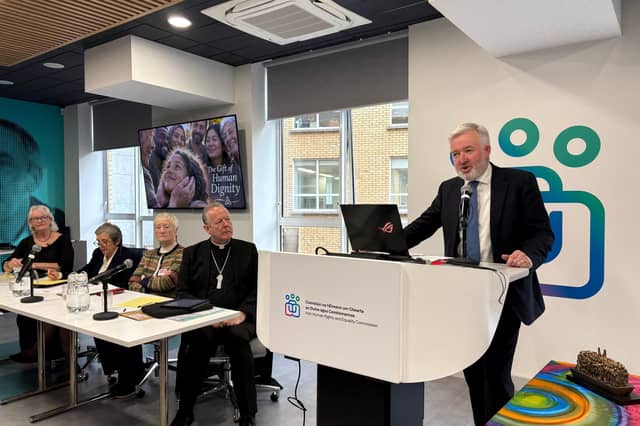

Delivering the keynote address at the 20th anniversary conference of Act to Prevent Trafficking, Archbishop Eamon Martin highlighted the ongoing reality of human trafficking and the need for greater cooperation between governments, businesses and digital platforms to prevent it.
Human trafficking remains "one of the great scandals of our world today" and new technologies are creating fresh opportunities for exploitation, according to Archbishop Eamon Martin.
Delivering the keynote address at the 20th anniversary conference of Act to Prevent Trafficking (APT), titled Human Trafficking in a Digital Age, the Archbishop warned that modern slavery continues to affect millions of people across the world and often remains "hidden in plain sight".
Opening his address, he reflected on the sculpture Let the Oppressed Go Free, which was displayed at St Patrick's Cathedral in Armagh in 2023. The artwork honours Saint Josephine Bakhita, the patron saint of victims of human trafficking and modern slavery.
The Archbishop said the sculpture highlights "the bitter reality and profound impact of the human trafficking and forced migration of real people".
"Real people, with faces and voices and loved ones; real people, yearning for a better life because of the effects of wars, economic and social upheaval and other injustices," he said.
"Real people, mostly women and children, whose vulnerability has been seized upon by others who seek to exploit them in so many ways."
Describing trafficking as "one of the great scandals of our world today", he also repeated the words of the late Pope Francis, who described human trafficking as "an open wound on the body of contemporary society" and "a scourge upon the body of Christ".
The Archbishop praised APT for its work over the past 20 years in exposing an issue that often goes unnoticed by wider society.
"You have courageously raised your voices to challenge the global indifference that sadly shields the plight of our fellow human beings, especially women and children," he told delegates.
"Your work is not only essential, but it is also prophetic because, like Sister Josephine, you lift the trapdoor cover, you open the eyes of society and the Church to the harrowing truth of trafficking."
Referencing a recent cross-border investigation into human trafficking, the Primate of All Ireland said the crime is not something that happens elsewhere, but exists much closer to home.
"What struck me was that the criminal exploitation of vulnerable people is happening very close to where I live; it is happening all around us," he said.
"It is happening all around us, in this case across the north, with victims mainly from Brazil being used and abused, sexually exploited and treated like commodities."
The Archbishop said it is estimated that around 50 million people worldwide are victims of modern slavery and warned that the digital age is helping criminal networks expand their activities.
"Today's APT anniversary conference highlights the ongoing reality of human trafficking here, and in particular it draws attention to how the new digital age, with its fast global online crime network, is making matters worse," he said.
Drawing on the teachings of Pope Leo XIV, Archbishop Martin highlighted concerns about what has been termed "cyber-slavery", where traffickers exploit vulnerable people through online platforms and digital technologies.
He said communication and payment technologies must not become "instruments of recruitment and control" and called for greater cooperation between governments, businesses and digital platforms.
Throughout the address, Archbishop Martin repeatedly returned to the issue of human dignity, arguing that every victim of trafficking must first be recognised as a person rather than as a commodity.
"The dignity of the human person is the fundamental basis for all moral opposition to human trafficking," he said.
He added: "Human trafficking flourishes when human beings are allowed to become invisible; when economic advantage takes precedence over human dignity; and, when fear or vulnerability prevents someone from seeking help."
Speaking about the impact of trafficking on victims, particularly women and children, he said: "What is particularly disturbing about human trafficking is not only that one person exploits another. It is that, in the process, the humanity of the other person is ignored."
"Human trafficking reduces a person to a source of income, a transaction; a human being becomes something to be used."
The Archbishop also drew parallels with the experience of St Patrick, who was trafficked to Ireland as a teenager, noting that the country's patron saint later spoke out strongly against slavery and human exploitation.
Concluding his address, he paid tribute to Act to Prevent Trafficking and urged society to remain vigilant as technology continues to evolve.
"As technology advances, our compassion deepens, our commitment to justice grows, and our respect for every human life remains unshakeable," he said.
He ended with a call to remember the value of every individual, adding: "Every life is a gift. Every person has dignity. And every human being matters."