

Field of Dreams
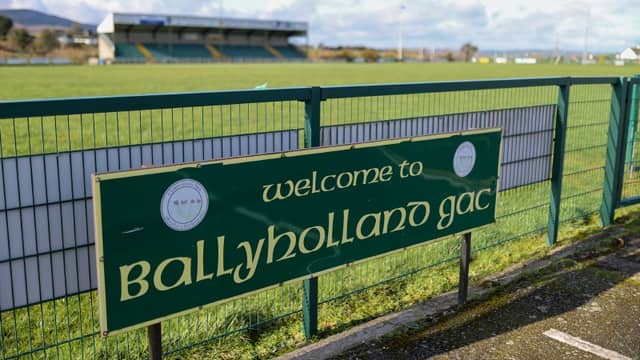

NO clubs back then had a field of their own, but they all had good fields, farmers fields, still it was hard to get a level field in Ballyholland with all the rocks. Anyway, they got a field up near the school and it belonged to Jack and Frank Colins. The fee for the field was £30 a year. None of their ground led into it, so they had to get permission from another man Eoin Smith, to put a path down his side to get access to the fields, he charged £5 for it.
NO clubs back then had a field of their own, but they all had good fields, farmers fields, still it was hard to get a level field in Ballyholland with all the rocks.
Anyway, they got a field up near the school and it belonged to Jack and Frank Colins. The fee for the field was £30 a year. None of their ground led into it, so they had to get permission from another man Eoin Smith, to put a path down his side to get access to the fields, he charged £5 for it.
“We had to get the cows off the field in Ballyholland,” said Gerard McGovern.
“Cattle seemed to accumulate around the goalposts and the goalkeepers would be destroyed with cow muck unless the cow clap was dry and you could shovel it off. That was conditions that they got the field, that cows could still use it.”
Fr Lynch got the goalposts from Halls at Narrow Water; they were given to him as a gift. A tractor and trailer was needed take them up the back fields.
“It was a big event when they arrived at the field and holes had to be dug. The men were there to dig the holes and there was a lot of volunteers to help out,” McGovern said.
“The field so happened to be situated in the townland of Grinan and there was a shuck along the bottom of it and you cross that and you are into the townland of Ballyholland.”
Dressing rooms were non-existent, players got changed behind a ditch or if anyone drove a car they might have changed in it. But Ballyholland people aren’t known for their lack of innovation and it didn’t take long before the thinking caps produced results.
Volkswagen cars were being assembled in Dublin and crates the parts were sold in Newry.
“Two men were delegated,” said McGovern.
“Arthur McAteer and Petsy Doran were tasked to collect them in the market and they used the crates to build dressing rooms. People would have looked at the big VW on the side and ask us where did we get them?
“They were there as long as we were in that field until 1966/67.
“There were the best of footballers from Armagh and Down played there in tournaments in the 60s. They played in that field up until the late 60s, they lost it because the farmers wanted it back.
“So, they had to leave and played down at the rugby field [no Telford Park]. Ballyholland got to rent it for two or three years because in 1970/71 they bought the field that they are in today.
“It was a farm and there was five fields. Father Davies would have been involved and the persuaded Mrs Sands too sell but she didn’t believe that Ballyholland Harps would have the money to pay her, that was her fear.
“However, they raised the money through voluntary contributions and money from the bank and she had her day at the house and that is all she wanted. It cost £6500.
“That was big money then. There was nine acres and a dwelling house. Sure, it may as well been £10000 because I think there was £200 or £300 in the kitty.
“They had it paid for in two years, when your back is against the wall…”
It took a lot of courage and conviction to go for the pitch the club members had wanted for a long time, which spoke volumes about the ambition the committee of Ballyholland Harps had.
They took away the ditches and played in the same part of the field that they did in the 1940s and then developed the pitch in the 1970s.
Ballyholland then built a new building and had it ready for the official opening of the new field in August 4,1984. It was blessed by Bishop Brooks and opened by GAA President Paddy Buggy.