

'We have lost the battle for the trees '- Eamonn Burke
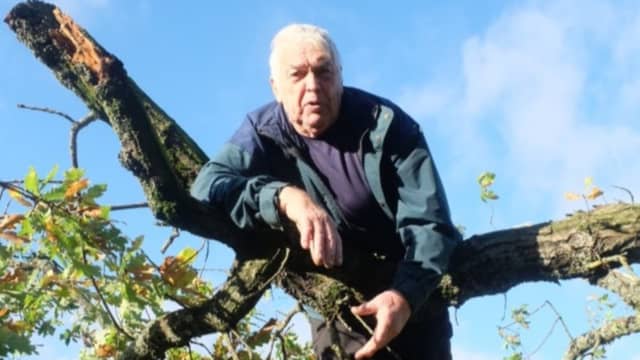

DESPITE exhaustive efforts taken on the part of Newry man Eamonn Burke to see that the row of Oak tress close to the Warrenpoint road remain in place, the trees have since been cut down by the Department of Infrastructure.
DESPITE exhaustive efforts taken on the part of Newry man Eamonn Burke to see that the row of Oak tress close to the Warrenpoint road remain in place, the trees have since been cut down by the Department of Infrastructure.
The trees, which were primarily oak and ash, and numbered over 25, were cut down by the DfI in order to facilitate for the construction of proper flood defence infrastructure as part of the Newry flood alleviation scheme.
Despite the reasons cited by the DfI regarding why the oak trees, which have been standing sentinel at the site located close to the Greenbank industrial estate for over 200 hundred years, had to be removed, in the opinion of Mr Burke, who has been rigorously campaigning to protect the trees since the DfI first began work on the site in February of this year, “it was not necessary at all to take the trees down.”
“It was not necessary at all to take the trees down. Perhaps there would have been some sense in the construction of the flood defence infrastructure if there was a river running behind the trees, but it is only a shuck. The only water that is going into this shuck is water that is flowing out of the Greenbank Industrial Estate and a small amount of run off from the motorway and that is it.”
Mr Burke related the harrowing moment in which he found out that personnel from the DfI were on site to remove the trees in the early hours of last Wednesday morning, with the nature enthusiast stating that he believes that the DfI chose this time of day to begin work on removing the trees so that both he and the many other citizens of Newry who were also opposed to the DfI's the trees “couldn't go in to do anything to stop them”
“Now we have lost the battle for the trees, it is over. The last of the trees that were still standing were cut down at around 4 or 5am last Thursday morning. I got a phone call at around 8.30am last Wednesday morning. Apparently, they moved in at 2am last Wednesday morning. There must have been a considerable number of workmen doing the job because they had almost all of the trees down bar one by the time that I found out at 8.30am on Wednesday morning. They just dropped the trees on top of one and other and they just wanted them down.
“I was down near the Greenbank all day on Wednesday trying to protect the last tree from being cut down. I stayed until 1.30am last Thursday morning to try and protect the last of the trees from being cut down. After I left, they brought the machines back in around 4 or 5am on Thursday morning and cut the last of the trees down. I have lost the battle that I have fought from day one, but the Department of Infrastructure were determined to have their way
“ This all happened under the cover of darkness and no one knew anything about it at the time, not a thing. They chose this time of day to begin cutting the trees down so the protestors couldn't go in to do anything about to stopped them, this is the way they do it. Counting the Ash trees near to the site as well the Department of Infrastructure have cut down about 25 or 28 trees in total near to the Greenbank Industrial Estate and I am totally disgusted.
“Now that the trees have been felled, I feel completely sick. I use to go down to the Greenbank regularly with my dog for walks but I don't think I will be visiting the site for some time now after this. I simply cannot stomach it, to see that the trees which have stood in that spot for the past 200 hundred years have been cut down, it is just a big open space now.”
FLOODING
Mr Burke elaborated on why it is he believes that the removal of the iconic Oak trees along the Warrenpoint road on the part of the DfI to facilitate for the implementation of the measures detailed in the flood alleviation scheme were in his opinion completely unnecessary, citing the fact that the Warrenpoint road has not flooded in over eight years thanks to the protective measures introduced to safeguard the drainage infrastructure that is already in place in the area. According to Mr Burke this is a point that he made the Department of Infrastructure aware of.
“The problem was never with the tree bank near the industrial estate, the problem was where the shuck ran off near to the Clanrye river. There was one particular morning where the drainage system failed eight years ago in October of 2015 and this allowed the sea to come in. I recently consulted an individual who works for the Rivers Agency and I asked them where it is the water came from on that particular morning in 2015 and he told me that it came from the sea.
“This happened because the drains just failed. One of them hasn't worked for the past number of years and there is another one, a backup drain and it failed because some sort of debris came down the shuck and it jammed in the gate of the drain and kept it open. This meant that whenever the incoming tide from the sea came in it had a straight run through and the flooding ended up all the way up to the roundabout on the Warrenpoint road.
“After this happened the valves on the drains were changed and there was screening put over the top of the walls. This was to stop people from throwing debris down into the drains and to stop stuff from floating down. The Warrenpoint road has never flooded after this. So this hasn't happened since 2015 because the valve on the drain was changed and it was doing the job of draining excess water extremely well. Thanks to this the road has never flooded since then.
“I informed the Department of Infrastructure about this, but I may as well have been talking to a stone wall. We had a meeting with the Department of Infrastructure a number of weeks ago and I asked a representative from the River Agency, whom I have already meet a few times regarding where the water came from on that particular day when the Warrenpoint road flooded in 2015 and he told me that they didn't know. I told him that there were gallons of water that flooded the road that day and they didn't know where it came from? I had a meeting with one of the other engineers that was involved in the creation of the flood defence measures and I asked him the same question, where did the water come from on that morning in October 2015 and he told me that it came off the carriageway.
“At the beginning I also asked the DfI if they could implement a soil bank in case of flooding and although they did initially deposit some quantity of soil on the ground, they then went on to tell me that the ground was not suitable to hold soil. Another possible alternative to removing the trees that I suggested was pudding clay. To give an example the bottom and the wall s of the Newry inland canal from Newry to Portadown are lined with a type of clay known as pudding clay to stop leakages out of the Newry Canal. I asked the DFI if they couldn put a pudding clay bank down in front of the oak trees and I was told by the DFI the ground underneath the bank is not suitable to hold it.”
DEPARTMENT JUSTIFY REMOVAL
When asked to provide a comment regarding why it is the Department of Infrastructure believed the removal of the trees on the Greenbank Industrial Estate was a necessity to facilitate the construction of proper flood defence infrastructure a Department spokespersonresponded that
“The flood risk in this area is real and continuing. Alternative methods were exhausted. Given the topography of the industrial estate it will act as a bowl and flood waters, once they enter, would be slow and difficult to remove. Risk of entrapment to people in the estate would be significant. The trees were removed to ensure site safety. We could not knowingly allow them to remain with the resultant safety risk, nor can we avoid completing the scheme without the risk to life and property from flooding. “