

Gallagher: 'People need to wake up and smell the coffee'
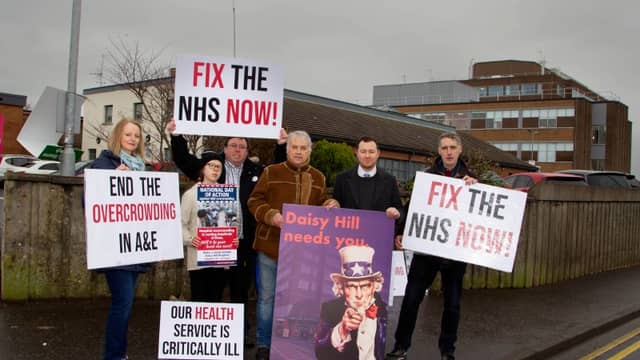

DAISY Hill Action Group chairperson Francis Gallagher says that more needs to be done to improve life for patients and staff at Daisy Hill Hospital and warned that getting Stormont up and running won’t provide all the solutions, writes Steve Malone. “This protest is really to highlight that the overcrowding at Accident and Emergency is unacceptable. This is a symbolic gesture. The different hospital campaign groups all over Ireland came together on today [Saturday] to protest about the overcrowding in A and E,” Gallagher said.
DAISY Hill Action Group chairperson Francis Gallagher says that more needs to be done to improve life for patients and staff at Daisy Hill Hospital and warned that getting Stormont up and running won’t provide all the solutions, writes Steve Malone.
“This protest is really to highlight that the overcrowding at Accident and Emergency is unacceptable. This is a symbolic gesture. The different hospital campaign groups all over Ireland came together on today [Saturday] to protest about the overcrowding in A and E,” Gallagher said.
“This is non-political, we are showing our solidarity to all the other groups.
“The Southern Health Trust and the Department of Health need to start creating an action plan together to help alleviate the problem. Furthermore, the whole system of governance of the Health Service needs to be looked at and the Executive needs to be more accountable to the public and the patient.
“We also need the make people aware that getting the Northern Ireland Executive up and running in its current form isn’t going to solve the issues, in fact it could make matters worse because it needs to be reformed.
“On their watch over many years the NI Executive should have been training more doctors and nurses and had been doing that then we wouldn’t be is such a bad situation we are in now.”
The consultation period begins in February, and Gallagher believes that the public have to demand change in the way the Health Service is run.
“The thing is how do you sort it out?
“Our view is one way to do that is make the Department of Health more accountable. We don’t want the Executive to come back to deliver more of the same, more long waiting lists and more pain.
“There is going to have to be a fundamental look at how go forward. We don’t want the type of reform that is downgrading local hospitals taking away general surgery, which really undermines the acute status of Daisy Hill Hospital.
“That is not the type of reform we are looking for. We think we should be training more general surgeons. All of this I suppose is in the melting pot and needs looked at.
“The consultation period will be starting soon and we would urge people, that now is the time to mobilise and we need to wake up and smell the coffee and realise that if people don’t make their voices heard now to save the emergency general surgery, then the whole acute hospital will be totally undermined.
“You can’t run an acute hospital without general emergency surgery, if you take it away, then your ED department is automatically downgraded from a Level One to Level Two ED department.
“Today is the first step of getting a mass campaign organised, starting really from when the consultation period opens, which will be February.”
Gallagher is not in agreement with the Bengoa Report, which was first published by then Health Minister Michelle O’Neill in 2016 but feels that it does contain some good points.
“These elective hubs are a good idea, because what that means is that someone won’t be knocked off a list to get an operation if an emergency case comes in. So, anyone who has planned elective surgery will go ahead, so that is a good thing,” said Gallagher.
“The danger is that could be a Trojan Horse, where they are given us with one hand and with the other one taking away emergency general surgery. So, if we are not very careful, we could be left with a hub for elective surgery and a Minor injuries unit.
“If people have to travel to Craigavon in an emergency, medical professionals have told us that it will lead to poorer outcomes for patients and there might be lives lost if people have to travel from Culloville to Craigavon on a wet, winter night. Even getting an ambulance could be a problem.”