

Banjo looks back twenty years after having conquered Everest
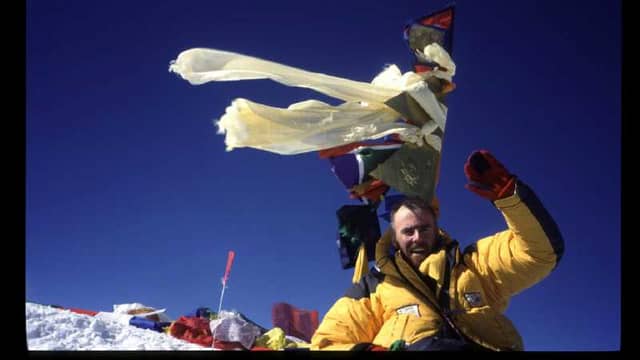

TWENTY years ago, Terence “Banjo” Bannon made history by becoming the first man from Newry and the second man from Northern Ireland to overcome the arduous 29’000-foot ascent up the north side of Mount Everest and sit proud a top the summit of the world's tallest mountain. Although this otherwise normal man from the Barcroft Park in the city was pitted as the underdog in the party whom he travelled to Everest with in 2003 to tackle what for many practitioners of mountaineering is considered to be the ultimate test of their ability, against all odds Banjo bested every challenge that stood in his way, reaching the mountains summit at 8am on the morning of May 31 2003, firmly cementing his place as an irrefutable icon who’s legend will forever be remebered by the people of Newry, Mourne and Down.
TWENTY years ago, Terence “Banjo” Bannon made history by becoming the first man from Newry and the second man from Northern Ireland to overcome the arduous 29’000-foot ascent up the north side of Mount Everest and sit proud a top the summit of the world's tallest mountain.
Although this otherwise normal man from the Barcroft Park in the city was pitted as the underdog in the party whom he travelled to Everest with in 2003 to tackle what for many practitioners of mountaineering is considered to be the ultimate test of their ability, against all odds Banjo bested every challenge that stood in his way, reaching the mountains summit at 8am on the morning of May 31 2003, firmly cementing his place as an irrefutable icon who’s legend will forever be remebered by the people of Newry, Mourne and Down.
Now with two decades having elapsed since he fulfilled his life's dream of joining the elite echelon of mountaineers who have proven themselves to be the David to Everest’s Goliath Banjo has come forward to tell the story of not only his own experience on that fateful day 20 years when he found himself in a place where even angels would fear to tread, but the circumstances that lead to him making the decision to undertake this herculean task that has claimed the lives of many a mountaineer before him.
According to Banjo, his love of climbing can be traced back to the outdoor excursions which he took part in as a teenager that were facilitated by the Barcroft Community Association.
Humble Beginnings
“I am from Barcroft Park in Newry. I am a sixties child as I was born in 1967. I attended the Abbey primary CBS primary school and then Saint Jospeh's School. From here I went on to the tech and then I was a fitter and welder by trade.
“When I was growing up in the 70's economically, socially and politically the place was going mad. The 70's were crazy in Newry. It was one of the most bombed out towns anywhere in Europe at this stage.
“There was a youth club called the Barcroft Community Association. It was here at the age of 8, that I found my first love which was boxing. In the community association we would have done other sports as well to keep us out of trouble and give us something to do.
“The youth club would take us away to Shanngaghmore and their outdoor education centre. From this I developed a love for the mountains at a young age. At 14 I walked from one side of the Mournes to the other and this is what set me on the path of mountain climbing. I started rock climbing and I got on to an outdoor education panel. I was one of the youngest instructors at this time because I was doing it part-time in Shanngaghmore outside Newcastle. From this I began to learn navigation and map reading .
“From here I started going to different mountains around Ireland and then in Scotland. I was climbing in the winter time at a young age. I started rock climbing in the Alps and from this I started to climb different mountains around the world. Having grown up in a housing estate it was good to go out and see the world. After this I would start being asked to go on different expeditions and the more, I climbed the better I became.”
It was the skills that Barry would develop during his time as an instructor in Shanngaghmore that would ultimately serve him well during his many traversals of some of the world's tallest mountains, all OfCourse leading to the eventual zenith of his career that being the conquering of Mount Everest, the first attempt of which he made in 1993.
First-time around
“The first opportunity to climb Everest came in in 1993 when I was 25. I had a chance to go to with the first Irish expedition team to climb Everest, with Dawson Stelfox being the leader. Very few people were climbing Everest then but he went on to summit the mountain that year. He was the first man from the north to summit Everest.
“This was done the hard way. We went up the Chinese side of the mountain which is that bit more technical than the normal route which would be the south side in Nepal. I only got too 24'000 feet, with Everest being 29'000 feet. After 10 years I went back up this same route as I knew the logistics of how to get up this route. I wanted to Summit Everest in 1993 but I was only in the party as a back-up. However, I knew I wanted to go back up it.
“After 1993 I ended up going to Alaska and Canada. I climbed the highest mountain in Alaska which is also the highest mountain in North America called Mount McKinley also known as Denali as it is called now by its indigenous name. I also climbed mountains in South America and South East Asia.
“When I went back to Everest in 2003, I decided that based of my previous experience of climbing solo in the Himalayas there were not going to be porters or sherpas or guides, we would climb it alone by ourselves. We did not have much money behind us when we planned to ascend Everest. I remember that people would come up to us with the odd person giving us a few pounds here and a few pounds there. This wasn't a lot of money but it was enough to scrape through.
The Ascent
“It took us six weeks to climb Everest and you may ask why it took so long. I left on April 1 and I summit Everest on May 31. I initially meant to climb Everest with no Oxygen. However, At 8000 meters there was oxygen left up there and I took it because I ended up on my own. I didn't mean to be on my own but the man that I was with got frostbite so I ended up climbing the last day of the expedition solo to the summit of Everest.
“There are a lot of logistics involved when it comes to climbing Everest. I moved from Nepal into Tibet and you have to acclimatise and there were also storms that wrecked our tent, So we had to replenish our tents. The boys that were with me ended up getting frostbite in their fingers and toes. Once you get frostbite you can lose fingers and toes and one of the guys, I was with on the expedition actually lost three fingers and toes from climbing Everest. The team captain and expedition leader Richard Doogan was only about 300 or 400 meters away from the summit and he had to turn around because of bad weather.
“I was the weakest member and I was not picked for the summit team at the start and I did not acclimatise that well, but as time went on, I began to get better atnd climatise a lot better. We were constantly up and down because of the bad weather but it only actually took two days from the base camp to get to the summit. You climb at night, this is what I was told to do, I did this and it worked out well.
“I would have left the last camp which was camp 3 at about 10.30pm at night and then I climbed through the night. There are 3 technical parts on the North side of Everest. There is the first step, second, step and third step, but the second step would be the hardest step of them all. It is a struggle because you put one foot in front of the other. You move one, two, three and then take a deep breathe. I also ran out of Oxygen near to the summit. Once I got over this at 6'O'Clock in the morning it took me another 2 hours to get to the summit at 8 O'clock in the morning.”
Summit of life and descent of death
Somewhat ironically it was during the final stages of Banjos ascent of Everest whilst experiencing life at arguably its most invigorating and vivd that he would also face a sober reminder of the fact that the presence of death was not as distant as he would have otherwise preferred.
“When I got to the summit, I waved my hands in the air but there was no one about. It is like winning the world cup but there is no one there to cheer for you. I started taking photographs because I had to prove that I was there. I had one of the old throw away wind up cameras with no battery in them, I took selfies with this.
“Going back down Everest you deflate. I myself was exhausted, I wasn't eating properly and I wasn't sleeping properly but I had to push myself on because I passed five bodies and realised that most men, poor souls, get to the summit and then die on their way back down of exhaustion or else the altitude gets a hold of you. It is very scary as you don't think that you are going to die but on the way down you realise just how close to death you really are. You just have to hope that this doesn't happen to you.
“When I finally reached the base of the mountain all the sherpas at the bottom were in a line and they all congratulated me which I thought was lovely. It was not a normal thing to climb with no sherpas because without them about 99% of people will not climb Everest.
“It is a bit surreal because you look back and think, how did a lad from Newry end up on the highest mountain in the world? It is because I had a dream and an aspiration. Hopefully I inspired people that just becasue you come from housing estate it doesn't mean that you cannot achieve something if you just put your mind and a good bit of effort to it. Everyone has their own Everest.”