

Poor Things: Female reimaging of Frankenstein
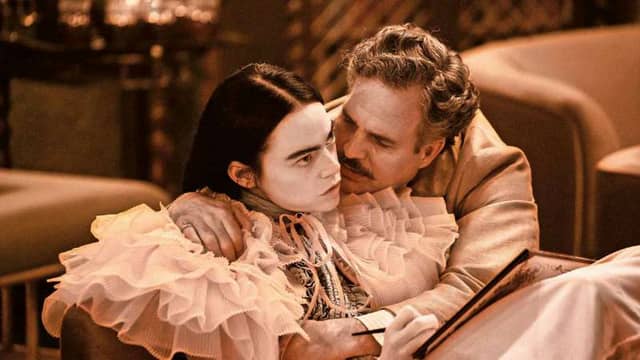

AWARD-winning director Yorgos Lanthimos reteams with Emma Stone for this entertaining and bizarre fantasy comedy. Based on the 1992 novel by acclaimed Scottish author Alasdair Gray, the film adapts the political themes of the original source and puts a delightfully unconventional progressive spin on it.
AWARD-winning director Yorgos Lanthimos reteams with Emma Stone for this entertaining and bizarre fantasy comedy.
Based on the 1992 novel by acclaimed Scottish author Alasdair Gray, the film adapts the political themes of the original source and puts a delightfully unconventional progressive spin on it.
Though liberties are taken with the book’s story, the changes are original enough to be justified. Lanthimos, perhaps best known films like The Lobster and The Favourite, takes full advantage of surrealist production design and a fully committed cast to craft an always amusing and frequently bonkers story of a young woman overcoming the most unlikely of obstacles to achieve some autonomy in her life.
In a kind of magic realist version of Victorian London medical student Max McCandles (Ramy Youssef) is invited to become the assistant of highly eccentric surgeon Godwin Baxter (Willem Dafoe).
Baxter is the victim of various deformities, mostly inflicted through scientific experiments. Max becomes acquainted to Baxter’s latest experiment: a young woman named Bella (Stone).
Though Bella at first appears to have some neurodivergent condition, the truth is far from that. Baxter reveals that Bella is the result of an experiment in which he transplanted the brain of a baby into the head of a young adult woman, the victim of drowning, who Baxter then reanimated.
As a result, Bella has the mind of a very young child. As Bella’s intelligence develops at a rapid rate, Max falls in love and asks for her hand in marriage. Bella agrees but the machinations of the caddish lawyer Duncan Wedderburn (Mark Ruffalo) complicate matters.
Craving to see the outside world, Bella persuades Baxter to allow her to go on a grand continental adventure with Wedderburn.
On her travels, Bella gets some idea of what the real world is like and how unlimited her capacity for learning and personal growth can be.
Poor Things is a film that exists on two levels and succeeds of marrying both of these together with remarkable skill.
The first of these has to do with the message the blackly comic story is trying to convey. The supporting performances (Dafoe and Ruffalo are both amusingly arch) are all very good but Stone is the key to ensuring the film’s success.
She guides us through this weird and wonderful feminist allegory of a woman finding her place in the world.
With quirkily constructed language and dialogue (that of an adult embracing society and culture with a child’s eye view) Stone’s character delights, confounds and baffles those around her. With a remarkable capacity for learning and forging friendships (whether it’s aboard cruise ships or in Parisian brothels), the character and Stone’s performance ensures this is a hilarious and surprising story that uses broad and bawdy humour to satirise social norms of both past and present and push a positive message of enlightenment and open-mindedness.
Secondly, the production design Lanthimos uses helps him in achieving these storytelling aims.
The sets, costumes and cinematography invoke the works of surrealist painters like Dalí or Magritte. With these elements, the director envelopes the story with a kind of modernist comedic style that ensures that despite the potentially dark themes, the overall tone of the film remains light-hearted and hopeful. It also draws a contrast between the kindness and intelligence of the protagonists and cruelty and stupidity of the villains.
Poor Things is as eminently watchable as it is remarkably unconventional.
RATING ****
Matthew McCaul